E-commerce reporting fails in a specific, expensive way. The dashboard, the
finance export and the ops spreadsheet each compute "revenue" from a slightly
different slice of the same raw events, and nobody can say which one is right.
The fix is not a better dashboard. It is one modelled layer every consumer
reads from, fed by a pipeline that can be replayed when the definitions change.
Orders arrive continuously, so a nightly batch leaves operations blind for the
whole working day.
Constraints
Built solo as a deep engineering project, so the constraint set was chosen
deliberately: everything runs locally on Docker Compose, reproducible from a
clone with one command, with no cloud account required. The design still had to
be honest about scale, which is why the write-up includes a reference
architecture mapping every component to its managed AWS equivalent rather than
pretending Compose is production.Two more constraints came from the data rather than from the setup. Raw events
are messy and the schema drifts, so the pipeline has to survive that without
losing anything. And every transformation has to be re-runnable from source,
because business definitions change after launch.
How it's built
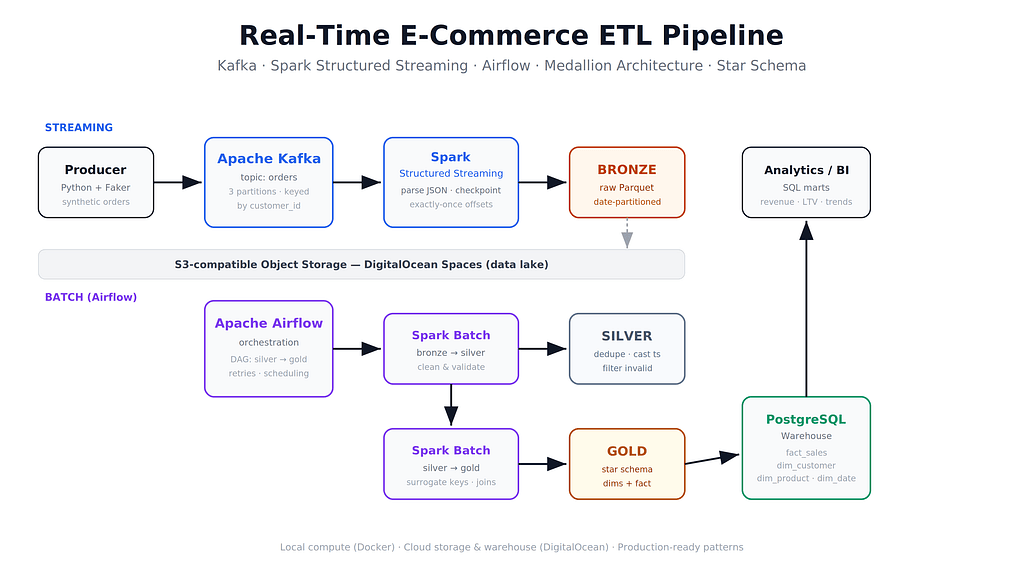
A producer publishes orders to a Kafka topic called orders, on a broker
running in KRaft mode so there is no ZooKeeper to operate. PySpark Structured
Streaming consumes that topic and writes raw Parquet to bronze on S3-compatible
object storage. Two batch jobs follow: bronze_to_silver.py validates
timestamps, drops null and invalid records and deduplicates, then
silver_to_gold.py builds the dimensional model in PostgreSQL.Gold is a star schema of four tables: dim_customer, dim_product, dim_date
and a central fact_sales keyed to all three. dim_date carries the calendar
attributes analysts otherwise recompute in every query, including a
is_weekend flag.
Scroll to see the whole diagramWhat I actually built. Kafka, PySpark, Airflow and Postgres, running on Docker Compose.The same pattern at enterprise scale is a different set of components doing the
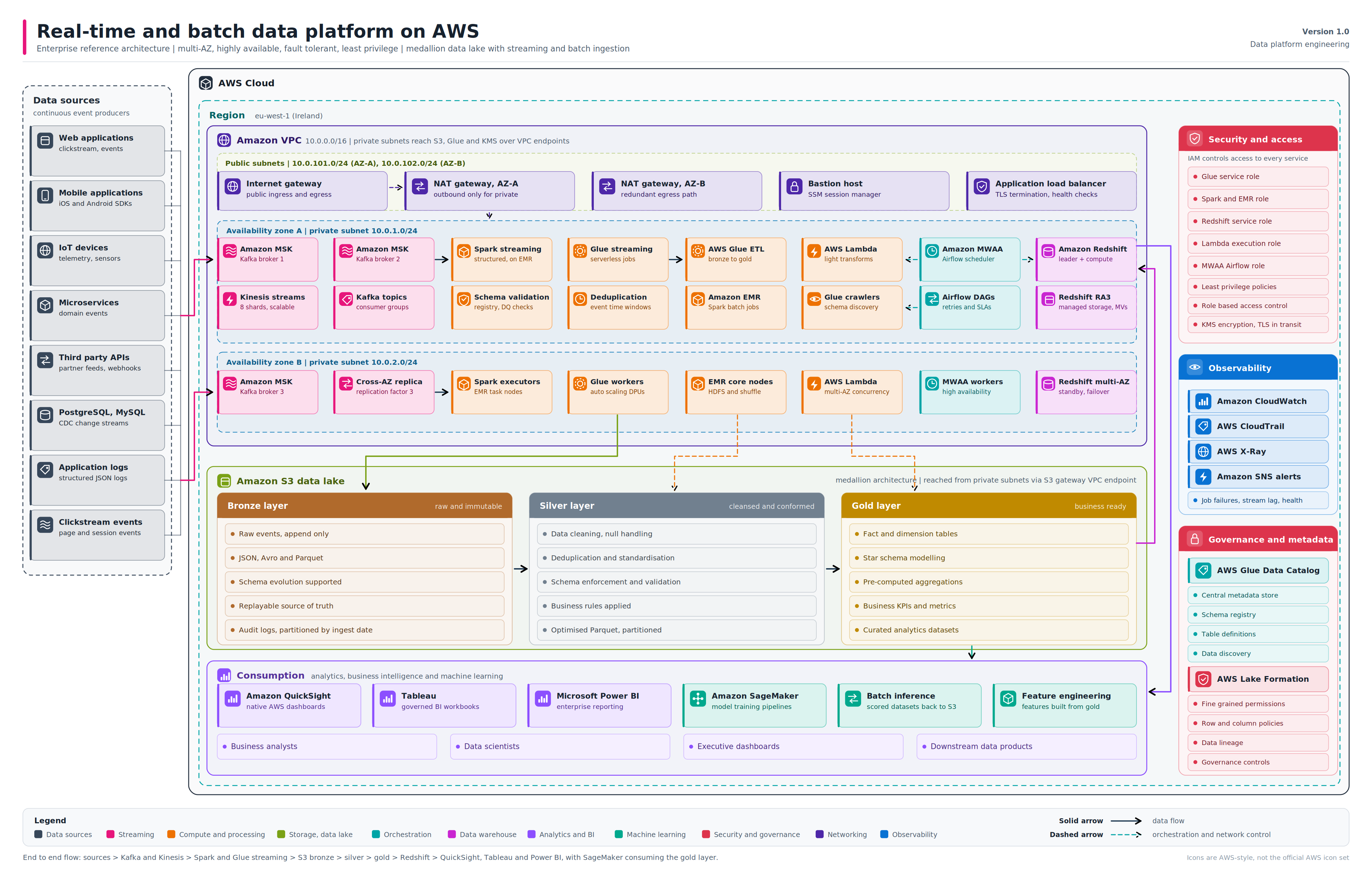
same jobs, and mapping one onto the other is most of what moving this to a
managed platform involves. I drew that mapping out separately, as a design
exercise rather than as a deployment.Reference architecture, not the shipped system
Scroll to see the whole diagramThe pipeline I built runs Kafka, PySpark, Airflow and Postgres on Docker Compose. This is the reference architecture I designed for the same pattern at enterprise scale on AWS, mapping each component: MSK for Kafka, EMR for Spark, MWAA for Airflow, Redshift as the serving warehouse.What Airflow does and does not own. The DAG orchestrates the batch half of
the pipeline and nothing else. The producer and the Structured Streaming job are
long-running processes started outside Airflow, because a scheduler built around
tasks that finish has no good way to own a task that never does. I tried
modelling the streaming job as a scheduled task first. It works until the first
run overruns its interval, at which point Airflow is either running two
consumers against the same checkpoint directory or refusing to run any. The
honest fix was to stop pretending the streaming job is a scheduled task and run
it as a service, with Airflow owning only the hourly bronze_to_silver >> silver_to_gold chain. The README states the split rather than hiding it.Measured on the Compose stack:
Sustained throughput: 2,800 events/sec through Structured Streaming
End-to-end latency, Kafka to gold: 4.7 minutes
Full rebuild of silver and gold from bronze: 8 minutes
Gold star schema: 4 tables, 3 dimensions around 1 fact, queryable from any BI tool without a join guide
Whole stack runs from one docker compose up: Kafka in KRaft mode, Airflow, Spark
Trade-offs I made
Medallion layering over a single transform. Bronze keeps raw immutable
Parquet, silver cleans and conforms, gold serves the star schema. The cost is
duplicated storage and more moving parts than one script writing straight to
final tables. The benefit is the reason the layers exist: when the definition of
revenue changes, gold is rebuilt from silver, and nothing is re-ingested.Streaming ingest, batch transforms. Kafka and Spark Structured Streaming land
events continuously, while silver and gold are batch stages on a schedule. Full
streaming end to end would cut latency but multiply the failure modes and the
operational surface. The dashboards this feeds do not need second-level
freshness, so the complexity was not bought.A star schema at gold, not a normalised one. Normalised would have been
tidier and would have pushed a join-writing tax onto every consumer,
permanently. Analysts and BI tools join dimensions to a fact table without help,
so the denormalisation is paid once at write time rather than every read.
What I'd do differently
The Airflow metadata database is SQLite, which forces the sequential executor
and means the DAG cannot run tasks in parallel even where the dependency graph
allows it. It was the right call for a laptop and the wrong one to leave in
place, because it silently sets a ceiling that has nothing to do with the
pipeline. PostgreSQL as the metadata backend is an afternoon of work and removes
the ceiling entirely.I would also add data-quality assertions between silver and gold from the start.
I caught a broken dimension join by reading output, which does not scale past a
handful of tables.
I’m open to full-time backend, platform and data engineering roles, and happy to walk through any decision on this page in more detail than it deserves.