A question-answering service over company documents has two failure modes that
matter more than answer quality. It can answer from the wrong tenant's
documents, which is a security incident rather than a bad answer. And it can
answer from nothing, generating plausible text when retrieval comes back thin.
This engine had to serve several tenants and several languages from one
deployment, guarantee retrieval could never cross a tenant boundary, and ground
every answer in retrievable, citable sources.The concrete use case was a localisation Q&A service: several tenants, each with
their own corpus, several languages, and answers traceable to a source rather
than confidently invented. For a localisation tool a confident wrong answer is
worse than no answer, because it gets shipped into a translation and nobody
re-reads it.
Constraints
Tenant isolation is a security boundary, not a filter. A missing WHERE clause is a data breach, not a quality regression.
Retrieval has to work across languages, not just English.
No third-party embedding API. Customer documents leaving the deployment was not acceptable, and per-token costs scale badly against re-indexing.
The third constraint is the one that shaped everything else. Running
intfloat/multilingual-e5-base inside the deployment rather than calling a
hosted embedding API is what makes "documents never leave" enforceable rather
than aspirational: there is no egress path for document text to take, so the
guarantee does not depend on anyone remembering it.
How it's built
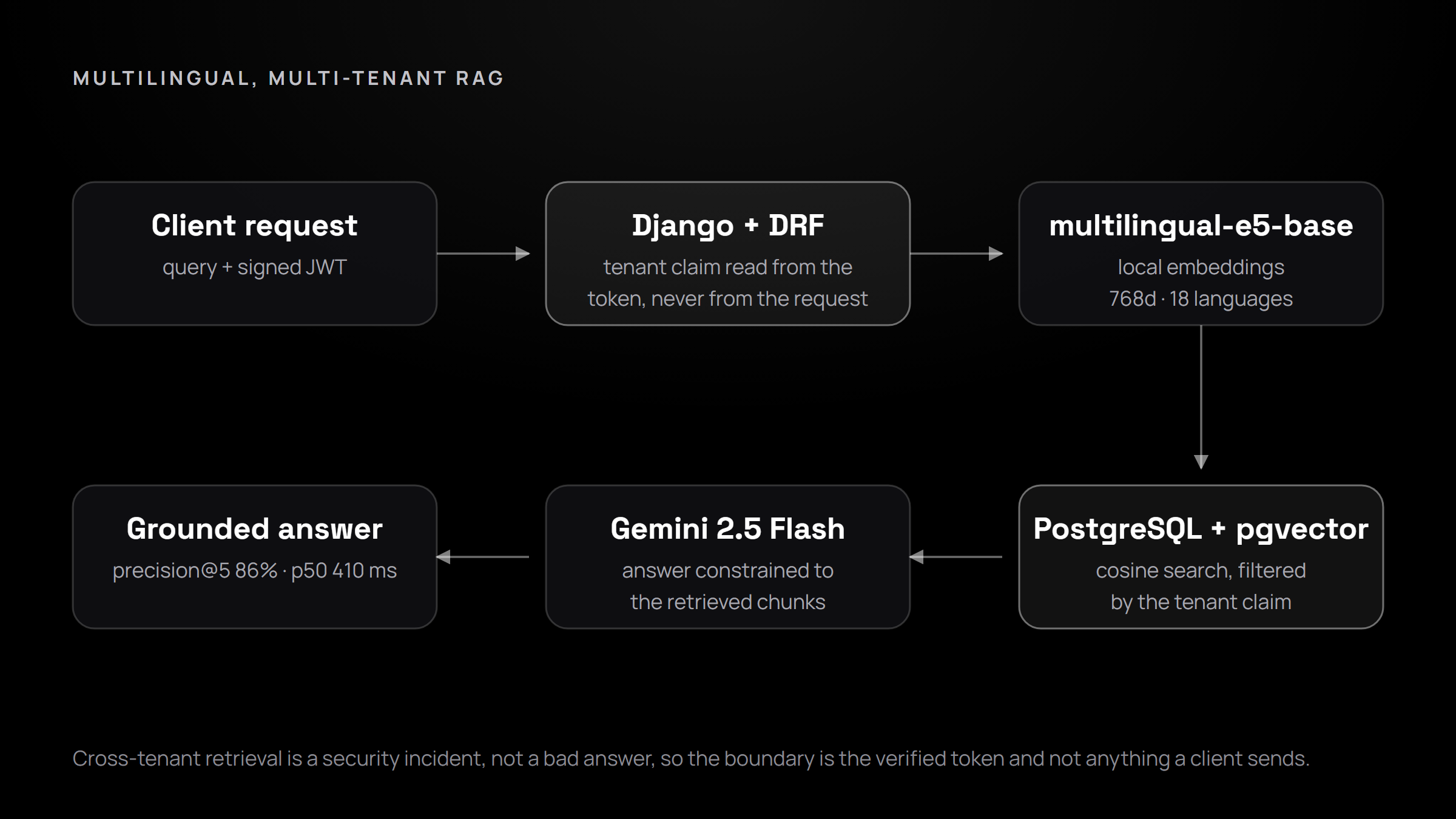
Django over PostgreSQL with the pgvector extension, enabled in the first
migration so the vector column exists before any model that needs it. Documents
are chunked, embedded locally with intfloat/multilingual-e5-base at 768
dimensions, and stored per tenant. A query embeds the same way and runs a cosine
similarity search scoped to the caller's tenant. Retrieved chunks go to Gemini
2.5 Flash with a prompt that constrains the answer to the supplied context.Tenant identity is written into the JWT at login and is never read from a
request parameter. Every retrieval query filters by the tenant claim on that
token, which is the isolation boundary. On registration the tenant is assigned
from the email domain, so a user cannot pick their own.Six prompt templates ship with it: qa, summarize, translate, glossary, extract
and explain. Seven endpoints cover register, login, refresh, query, ingest,
usage and health.
Scroll to see the whole diagramThe retrieval path. The tenant claim enters at the token and constrains every query after it, so isolation is a property of the request rather than of remembering a WHERE clause.The quota race, and the fix. The first version enforced quotas by reading the
tenant's usage counter, comparing it, then incrementing it. Under concurrent
requests that is a read-modify-write race, and a tenant near their limit could
exceed it by however many requests were in flight. It is the classic version of
the bug and it does not show up in single-user testing at all. The fix was to
make the check and the increment one atomic database operation, so the limit is
enforced by the database rather than by application logic that happens to run
first. Over-quota requests now return HTTP 429 rather than quietly succeeding,
and a reset_quotas management command clears counters on a monthly cycle.Measured:
Retrieval precision@5: 86% on a hand-labelled evaluation set
Tenants on a single deployment: 25
Languages covered: 18
Median query latency: 410 ms
External embedding cost: $0, because embeddings are generated locally at 768 dimensions and no document text leaves the deployment
Trade-offs I made
Tenant identity from the JWT, not the request. The tenant claim is read from
the verified token and applied as a retrieval filter server-side. The cost is
stricter auth plumbing and no convenient tenant switch for testing. The benefit
is that cross-tenant retrieval cannot be caused by anything a client sends,
because the client never gets a say.pgvector in PostgreSQL over a dedicated vector database. Embeddings live next
to the tenant and document rows they belong to, in one database with one backup
story, and tenant isolation is enforced by the same layer that owns the rest of
the data. The cost is a scale and ANN-tuning ceiling that a dedicated store would
push higher. At this workload the ceiling is theoretical and the operational
simplicity is not.Local embedding models over hosted embedding APIs. Documents never leave the
deployment and there is no per-call cost, at the price of a quality ceiling below
the best hosted models. For multilingual retrieval over private company
documents, keeping the data in-tenant won.Query-layer isolation over one deployment per tenant. A deployment per
customer isolates perfectly and multiplies operational cost by the number of
customers. Scoping retrieval keeps one deployment while making the boundary
explicit on every path that touches a chunk.Grounded generation. The model answers from retrieved context or says it does
not know. For a document Q&A tool a confident wrong answer is worse than no
answer, because it gets shipped downstream and nobody re-reads it.
What I'd do differently
I tuned chunk size by reading outputs before I had an evaluation set. That makes
every tuning decision a judgment call rather than a measurement, and it means I
cannot tell you whether the current chunking is better than the first thing I
tried. Building a small hand-labelled question set first would have cost a day
and made the rest of the work measurable.I would also have caught the quota race by writing the test before the feature.
Read-modify-write under concurrency is a known bug with a known shape, and I
wrote it anyway because single-user testing cannot see it. Anything that reads a
counter, decides on it, and writes it back now gets a concurrent test first, on
the grounds that it is the only kind of test that would ever have failed.
I’m open to full-time backend, platform and data engineering roles, and happy to walk through any decision on this page in more detail than it deserves.