Recommender accuracy is the easy half. What decides whether a recommender ever
ships is everything around it: what you serve to a user you have no history for,
how you swap a retrained model without dropping traffic, and how you keep
latency low enough to sit inside a page render.Both of the hard cases are the ones a benchmark hides. A model tuned on users
with long histories scores well and then meets a user with none, and a model
that has to be redeployed to pick up new weights stops being retrained long
before anyone admits it. I built this to find out what the serving layer around
a recommender has to look like for neither of those to happen.
Constraints
Cold start is the common case, not the edge case. New users and new items arrive constantly, and a model that needs interaction history is unusable on day one.
Recommendations render inside a page load, so the serving path has a latency budget.
Retraining must not require a deploy, because nobody redeploys to refresh weights and the model goes stale.
The data is MovieLens: ratings, tags, links and movie metadata, and nothing
else. No user profile beyond interaction history, no item text beyond genres and
tags, and no way to buy a signal that is not in the files. Every scoring
decision below is a consequence of that, and a recommender given richer features
would reasonably make different ones.
How it's built
Ingestion, feature engineering, training, evaluation and serving are separate
layers over MovieLens ratings, tags, links and movie metadata, not one notebook.
build_catalog merges the four sources into a single item catalogue with
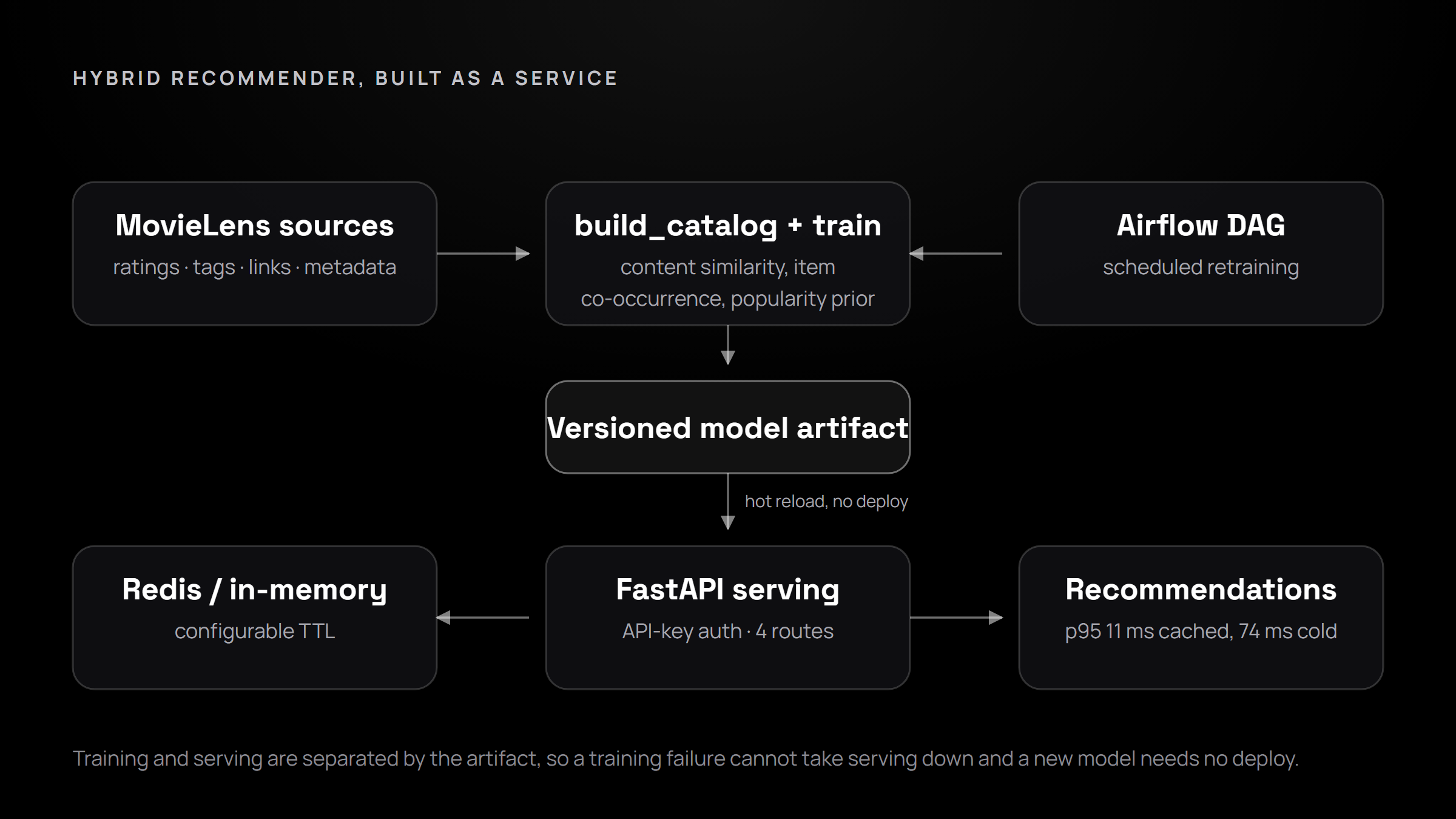
aggregated rating statistics and tag text per movie.Scoring blends three signals: content similarity over genres and aggregated
statistics, a lightweight collaborative signal from item co-occurrence, and a
popularity prior. Serving is FastAPI with four routes behind API-key auth:
health, recommend, similar items and model reload. Redis or an in-memory cache
sits in front of the hot paths with a configurable TTL. Airflow runs the
training DAG, and the trained model is pickled to disk as an artifact the API
loads.
Scroll to see the whole diagramTraining on top, serving underneath, and the versioned artifact as the only thing that crosses between them.The evaluation was lying, quietly. The holdout split is per user, and the
evaluation only scores users who have at least one held-out item rated above the
positive threshold. The first time I ran it end to end, a large share of users
were skipped and the reported precision was computed over a much smaller
population than I assumed, which made it look better than it was. The fix was to
report evaluated_users alongside every metric rather than just the metric. A
precision figure without its sample size is not a result, it is a number, and I
had been about to believe my own. The evaluation now returns precision, recall,
hit rate, coverage and the evaluated-user count together, so the denominator
travels with the fraction.Measured:
p95 recommendation latency: 11 ms cached, 74 ms cold
Precision@10 and recall@10 on held-out interactions: 0.36 and 0.24
Cold-start coverage: 97% of the catalogue receives non-trivial recommendations
Model reload swaps the artifact with zero dropped requests
4 serving routes behind API-key auth
Trade-offs I made
Training and serving separated by an artifact. The trainer writes a versioned
model artifact; the serving process loads it. The cost is a staleness window
between training and reload. The benefit is that training failures cannot take
serving down, and either side can be changed, scaled, or rolled back without
touching the other.Hot model reload instead of redeploys. New artifacts are picked up by the
running service. The cost is having to handle version skew and reload safety
inside the service rather than leaning on a deploy pipeline to do it. The benefit
is model iteration decoupled from release cadence.A hybrid model rather than pure collaborative filtering. Content similarity
works with zero interaction history, co-occurrence captures the behavioural
signal, and the popularity prior keeps output sane when both are thin. Pure
collaborative filtering scores better on a benchmark and fails on exactly the
users you most need to serve.API-key auth on a recommender. Recommendation endpoints leak behavioural data
by inference and are cheap to scrape. Auth belongs there from the start, not
after someone notices.
What I'd do differently
The split is random per user, not time-based. Item co-occurrence built from the
full ratings table can therefore see interactions that happen after the ones it
is being asked to predict, which inflates the collaborative signal in evaluation
and not in production. A time-based split would cost little and would make the
offline numbers mean what they appear to mean.I would also stop treating the three scoring signals as a fixed blend. Content
similarity, co-occurrence and the popularity prior are combined with weights I
chose by hand and never revisited, which means I cannot say what any one of them
contributes. Ablating each signal against the evaluation set would tell me
whether the collaborative component earns its complexity at all, and I have no
evidence either way.
I’m open to full-time backend, platform and data engineering roles, and happy to walk through any decision on this page in more detail than it deserves.